
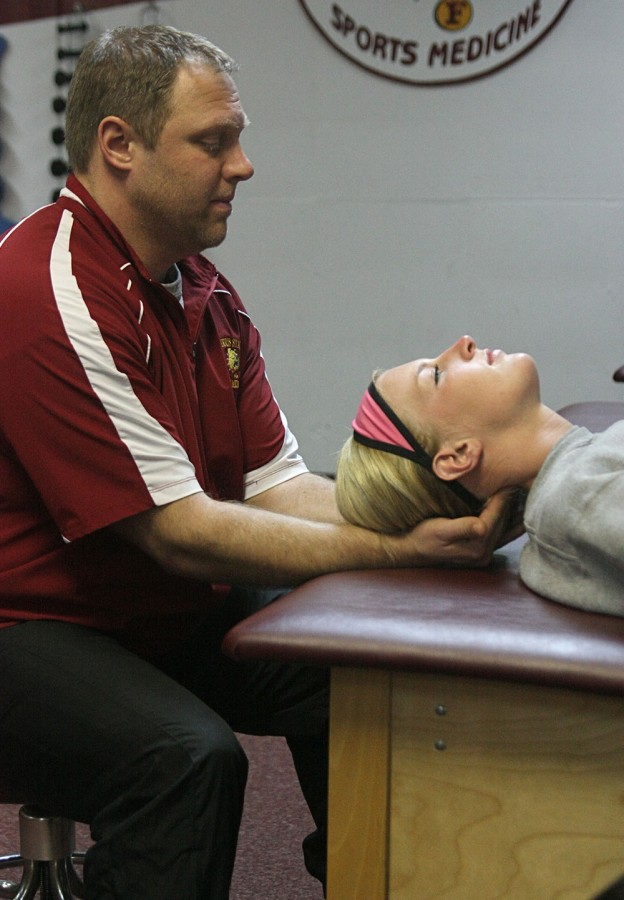
The front page of the next day’s local sports section is pasted with photos of the point guard who nailed the game-winning shot. But it’s an unlikely sight to see the team lifting the trainer on their shoulders after they’ve helped the star running back rehab a brutal knee injury.
The attention the star athletes get for winning the games is frequent, but it’s rare see the people who help behind the scenes who play into an athlete’s success. That is the life of an athletic trainer.
Trainers help players recover from injuries, help prevent injuries and keep themselves in shape for competition. But never does the post-game analysis show dedicate a segment of airtime to how vital the recovery plan that the trainer set-up for the running back helped get him back in time for the big game.
“Working as a trainer can be some of the most strenuous and stressful work that goes on in college athletics,” said Dave Lucey, who serves as the head athletic trainer for Ferris athletics. “But you’ve got to remember that these athletes don’t want to have to see us. We’re like the grim reaper.”
When looking at the Ferris athletics program, little attention is paid to the training staff and the work the individuals put in to keep the Ferris athletic teams healthy. But as Ferris has only three full-time athletic trainers for all of the athletic teams at Ferris, student trainers are a vital cog in the athletics machine for the Bulldogs.
“You can’t take things personal in this job,” said Jillian Erickson, who has worked as a student trainer for the past two years. “You have to realize that the athletes are going through a hard time…but it’s neat to see them go through the process of getting healthy and to know that you are part of that.”
It’s a difficult job to work as a student trainer in an athletics program at Ferris for the students who try to juggle the job, their social life and their school work. On top of that, these students feel the work that they do can be stereotyped at times.
“We do more than just hand the athletes bottles of water,” joked Justin Cooper, a pre-med student. “We have to work with all of the sports teams and it can be pretty demanding at times and I think people sometimes don’t realize this.”
From taking care of open wounds to taping up ankles, these students have to be multi-faceted with their skills as they do not have the luxury of working as a trainer for just one sport, like many major Division I schools do with their student athletes.
The student trainers must deal with a variety of sports injuries. Rehabbing a football player’s sprained ankle, getting a runner for track in shape for the next meet and keeping a basketball player from getting worn down in the middle of the season are some of the various tasks the students have to do and there is a great deal of responsibility placed on these students.
“These kids are the lifeline of this athletic program,” said Lucey. “I have to trust that they will be at a soccer practice or a football game when I’m not going to be there.”
Lucey says that while he usually gets a decent amount of freshmen to add to the staff in a given year, that number will dwindle down to five or six students that stick around after the training period, which takes a year to complete.
One of the skills that Lucey looks for his student trainers to excel at is to be able to communicate, not only with the athletic teams, but with each other.
“Teamwork and communication is the biggest aspect of this job,” said Erickson. “We have to be able to work well with each other and make sure everyone is on the same page.”
But for as much work that goes into the job and the lack of attention paid to their work, these students know their efforts are appreciated.
“The interaction is nice because we don’t get respect from the athletes at times, but even a ‘thank you’ for getting a bag of ice is nice to hear,” said Ali Wagner, who is studying health care administration at Ferris. “It’s better than sitting at a desk and not getting to see your boss and you get to see the athlete’s progress and we’re a part of that.” n