
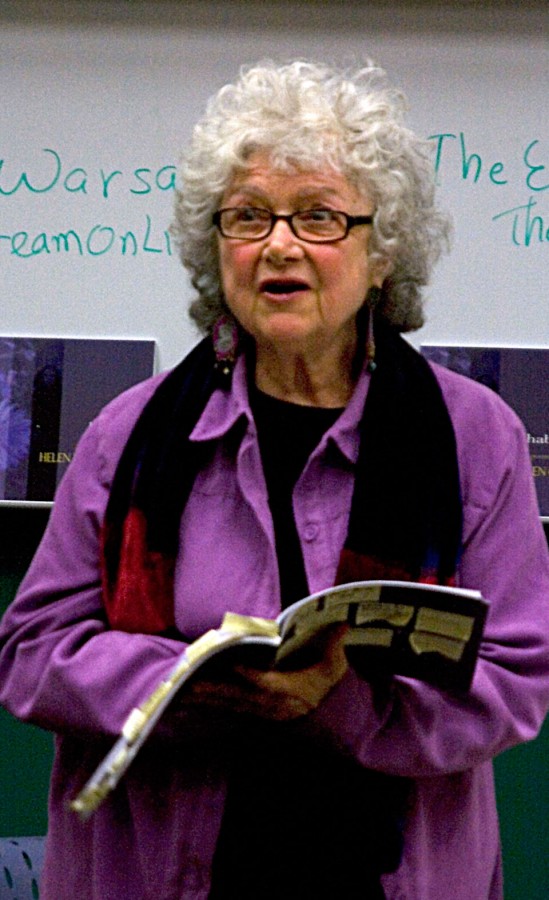
On Feb. 24, Cohen presented her Holocaust-themed poetry and Brysk presented her artwork on the same topic. Listening to the women talk about the Nazis invading Poland made me cry silently and reminded me of stories my grandmother has told me about her own experience during World War II.
Theresa Cwiek, my grandmother, or “Busia” in Polish, was raised in Poland just like Brysk and Cohen.
The Nazis invaded Poland in 1939. In the winter of the following year, Busia was working in a butcher shop when a Nazi entered. The soldier said something to her in Polish that she could not comprehend and slapped her across the face with a thick leather glove. She later lost her eye from this incident.
In 1941, Busia was taken prisoner by Nazis and spent seven months in Liebenau, a detention camp in Germany.
“We heard a lot of screaming,” said Theresa (Busia). “They were torturing the Jews.”
All three of these women endured unimaginable hardships and witnessed things that should never be seen by human eyes. Fortunately, due to their strength and determination, they were able to reach America, Busia in 1943 and the two other women in later years, and survive to tell their inspirational stories.
It’s easy for many of us to read facts and statistics about the Holocaust, but the most impact comes from looking at individual stories of human strength and sacrifice. As Brysk said, “You have to look at the Holocaust not as six million, but as individual faces.”