
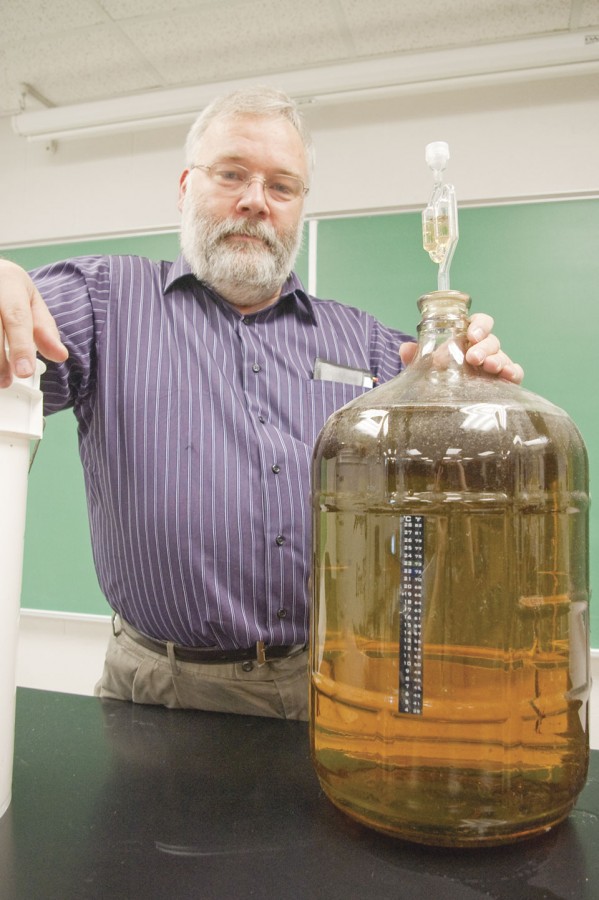
Thomson, became interested in brewing beer in graduate school. A member of his research group from Wisconsin was a home-brewer. He brought his beer to meetings and the delicious taste of the homemade beer sparked Thomson’s interest.
The main thing that pushed Thomson’s toward brewing was his wife. “I came home one day when we lived in New Orleans and she had bought all the stuff [brewing materials] and it was just sitting out on the front room floor,” said Thomson. “I don’t know what made her decide to do that; I guess you would have to ask her. I’m really glad she did, though.”
The complex process of brewing beer can be broken down into four main steps: mash, boil, ferment, then package. First, Thomson begins with grain, usually wheat or barley. “Sometimes rice or corn is used, but mostly wheat or barley because it’s the traditional ingredients,” said Thomson. “Grain is mostly starch, which is long chains of sugar molecules.”
The first step is to make malt; malting is getting the enzymes. The second step is mashing, which makes those enzymes active. The third step is to boiling; this step makes sure everything is sanitized and that unwanted bacteria is killed.
“Once you boil it, that’s where you get your flavor out of the hops,” said Thomson. “And then fermenting is where you put in the yeast, and the yeast converts the sugar into alcohol.”
His passion for brewing beer has taken him all over the world. After his freshman year of college, Thomson spent a year and a half in Peru. “South America and Puerto Rico have some interesting brewing traditions,” said Thomson.
“My goal is to eventually have a class [on brewing beer] that involves some study abroad,” said Thomson. In order for the study abroad to happen, at least 16 students need to sign up. Thomson is trying to get a class to go abroad in the summer of 2011.
“My interest is in Scotland, Ireland, and Belgium,” said Thomson. “It’s a matter of trying to find an easy way to do it that makes it affordable for students. One way or another, we’ll have something in the summer of 2011.”
The class will be offered this summer on FSU’s campus and will be called “Applied Fermentation Chemistry 290.” It will count as scientific understanding and will be worth four credits.
Thomson said he finds it difficult to choose his singular favorite beer. “Choosing my personal favorite beer is tough because it depends on so many other things: mood, temperature, and with or without a meal,” he said. His top three favorite international beers, in no particular order, are Guinness (a stout from Ireland), Chimay (a Belgian beer), and Pilsner Urquell (a Bavarian beer).
“I’m a big fan of drinking locally,” said Thomson. He enjoys beer from Founder’s, which is located in Grand Rapids, and also any beer from New Holland, which is located in Holland, Mich. “I’ve never had a bad beer from either one of them,” said Thomson.
In terms of connecting his hobby to the classroom, Thomson said, “It gives me application examples that students pay attention to. There are a lot of topics that we cover in general chemistry that are beer topics: chemical reactions, the role of heat, solutions, and gas laws. I use beer examples because it keeps students interested and it’s what interests me. I’m a teacher first and foremost and brewing is secondary, but it’s a chance for me to share a love of chemistry and a love of education.”